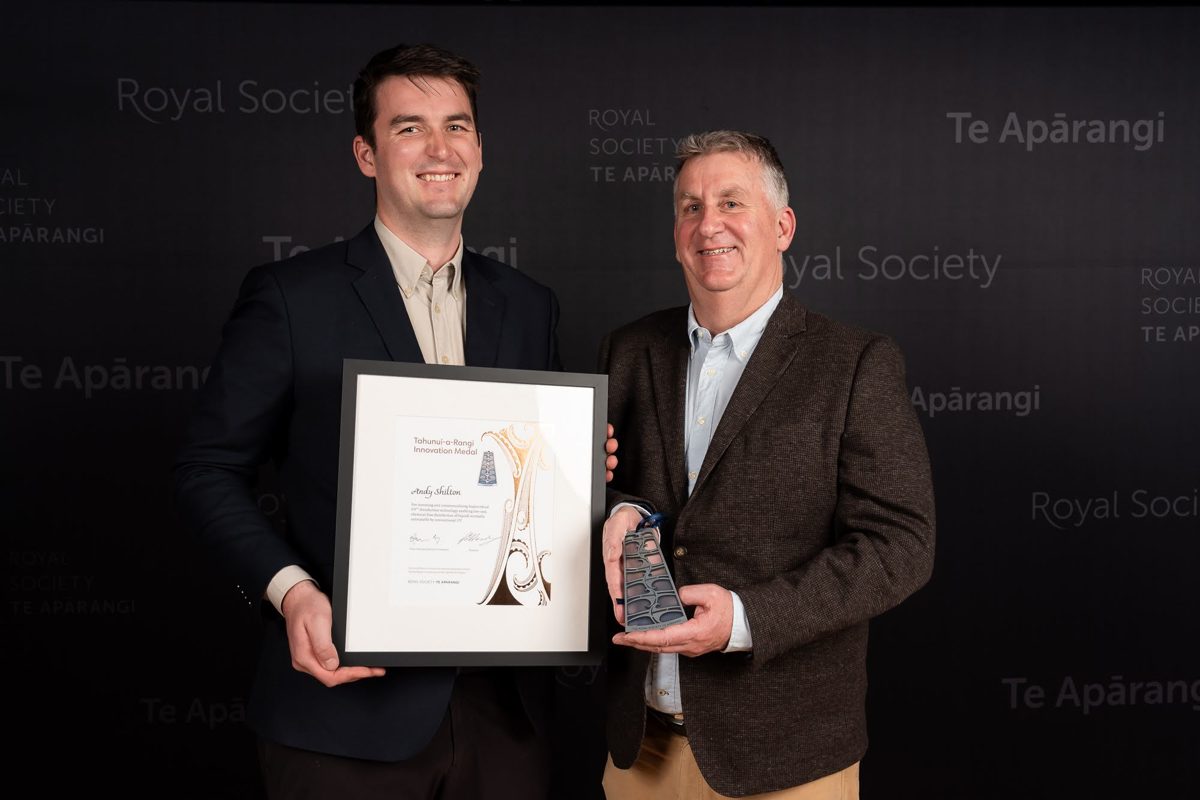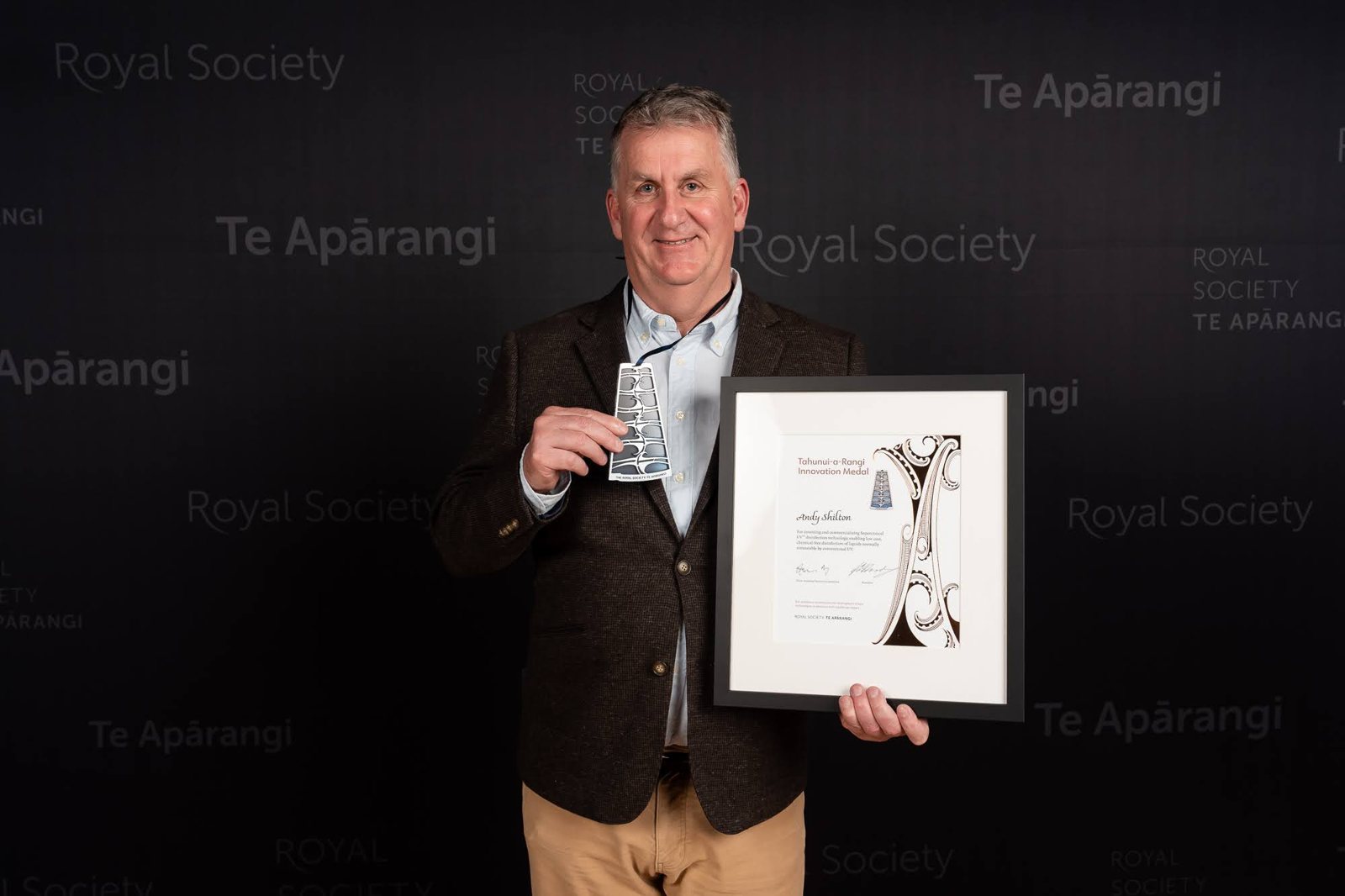
PALMERSTON NORTH, 29 October 2026: A Palmerston North engineer who was told as a schoolboy that he would never pass School Cert has tonight been awarded one of New Zealand's top honours for invention.
Emeritus Professor Andy Shilton, founder and chief technology officer of NovoLabs™, received the Tahunui-a-Rangi Innovation Medal from Royal Society Te Apārangi for inventing the Supercritical UV™ disinfection system. The technology disinfects wastewater that is out of range of conventional ultraviolet systems, efficiently and without using chemicals.
Like a sunbed for wastewater
Ultraviolet light kills bacteria and viruses very effectively, but it barely penetrates many liquids. Conventional UV systems submerge lamps in slow-moving water, but are only viable on higher-clarity liquids, which leaves councils and food processors often relying on chemicals, expensive membranes or having no viable disinfection solution.
Professor Shilton's answer was to change how the water flows. The Supercritical UV™ disinfection system spreads the liquid into a fast sheet just millimetres thick, like water racing down a dam spillway, under high-intensity ultraviolet lamps that work like a sunbed. NovoLabs™ systems have achieved >99.9% disinfection in liquids that let through less than 1% of ultraviolet light, where conventional UV systems generally need more than 40%.
"Ultraviolet light is brilliant at killing bacteria and viruses, but it struggles to penetrate into many liquids, and you can't treat what you can't reach," he said. "I couldn't accept that our communities and industries were often stuck choosing between chemicals, expensive membranes or no disinfection at all, so I started looking at whether changing the way the liquid flows could let the light reach every drop."
From a Massey shed to multiple continents
It was a long road from idea to industry. Prototyping began in a Massey shed around 2010, and the first production system went onto a working site in 2021. Along the way he was told the invention couldn't be patented, but it is now patented in 29 countries covering more than 70% of the world's economy.
"At school I was told I would never pass School Cert, and years later I was told that my invention wasn't patentable, so I've learned not to let doubters get in the way of what's possible."
Emeritus Professor Andy Shilton
NovoLabs™ spun out of Massey University in 2021. The company says its systems have since treated many billions of litres of wastewater commercially, from Northland to Southland, and have now been exported to Australia, Europe, and the Americas.
One recent example is Kaiwaka, in Kaipara District. Kaipara District Council installed a Supercritical UV™ disinfection system for under NZ$250,000, avoiding an alternative plant expansion estimated at almost five times that. The upgrade tripled the plant's wet-weather disinfection capacity, helping protect local waterways and the Kaipara Harbour during heavy rain.
Every unit is built in Palmerston North, and a NZ$5.55 million expansion, supported by an up to NZ$2.775 million loan from the Regional Infrastructure Fund, administered by Kānoa, the Regional Economic Development & Investment Unit within the Ministry of Business, Innovation and Employment (MBIE), is scaling up production as the company scales for export growth and moves into new markets including agricultural and horticultural liquids.
Lance Wiggs, co-founder of 2040 Ventures, whose Climate Venture Capital funds have invested in NovoLabs™, said the science is "compellingly elegant". "Thin, fast-flowing water is allowing UV light to reach and disinfect even very difficult-to-penetrate fluids. The technology outperforms anything the industry has seen, and new use cases in new sectors keep opening up," he said.
"The most satisfying part of the success of our technology is seeing outcomes like a rāhui lifted after more than a decade and families swimming in their local stream again, because it shows that industries, communities and a healthy environment can thrive together," said Professor Shilton.
What New Zealand should do next
"My vision is for the Supercritical UV™ disinfection system to become a new standard in ultraviolet disinfection," said Professor Shilton. "New Zealand should provide patient investment in research-led hardware companies and encourage industry and councils to back proven local technology. Deep tech takes years to mature, but it can build lasting export industries and skilled, meaningful jobs in regions like Manawatū."
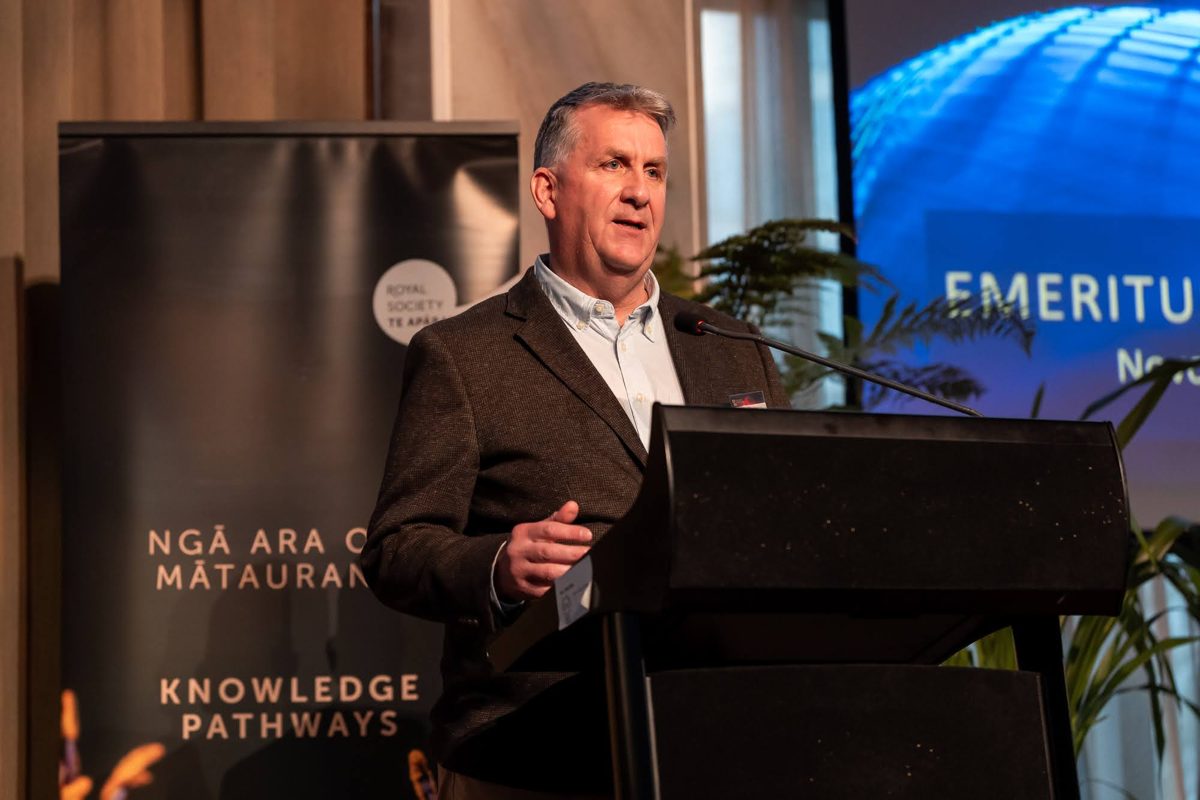
In accepting the award, Professor Shilton thanked his late mother, who told him to ignore the doubters, and the colleagues, iwi, councils and customers who backed the technology rollout.
Ends
About the Tahunui-a-Rangi Innovation Medal
The Tahunui-a-Rangi Innovation Medal is awarded by Royal Society Te Apārangi as part of Research Honours Aotearoa. It recognises a New Zealand-based person or team for excellence in invention and the development of new technologies or processes with significant economic, social, cultural or environmental impact. First presented in 2020, its name means "Great Glowing of the Sky" and refers to the Aurora Australis.
About Andy Shilton
Emeritus Professor Andy Shilton did, in fact, pass School Certificate. He went on to earn a Bachelor of Engineering (Civil) from the University of Auckland, then a Master of Technology in Biotechnology with First Class Honours and a PhD in Environmental Engineering, both from Massey University.
After working in environmental engineering design and consultancy in New Zealand and the United Kingdom, he joined Massey in 1993 to create New Zealand's first degree in Environmental Engineering, completing his PhD part-time while establishing and teaching the programme. At the same time he built a research platform that saw him promoted to Full Professor just five years after graduating with his PhD. His textbook Pond Treatment Technology has been described as the definitive work in its field, and he is a Fellow of Engineering New Zealand.
In 2021 he founded NovoLabs™ to take his Supercritical UV™ disinfection system to market and has served as its Chief Technology Officer ever since. Working with Massey's commercialisation team, he has brought the technology into full-scale use for councils and food processors. He was made Emeritus Professor in 2024.
About NovoLabs™
NovoLabs™ is a Palmerston North company and Massey University spin-out that designs and manufactures patented Supercritical UV™ disinfection systems. Its chemical-free technology treats wastewater and process liquids that conventional ultraviolet systems struggle to disinfect. NovoLabs™ systems have treated billions of litres in commercial service across New Zealand, Australia, Europe and the Americas. In 2024, the company won three NZ Hi-Tech Awards: Most Innovative Hi-Tech Hardware Product, Most Innovative Hi-Tech Solution for a More Sustainable Future, and Most Innovative Deep Tech Solution. It was also named Best Spinout at the KCA Australasian Research Commercialisation Awards.